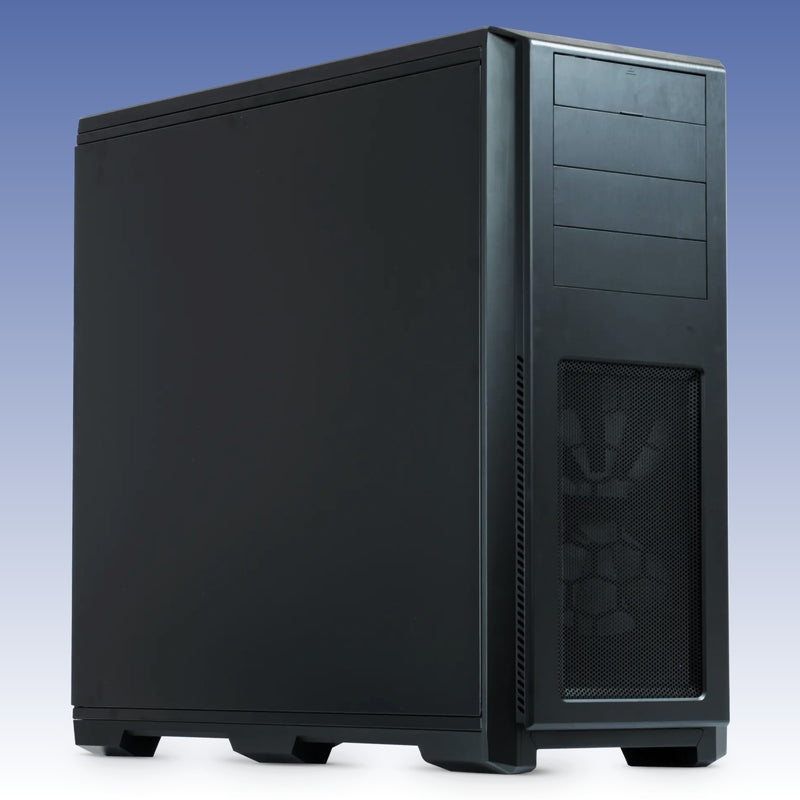

Power-users - Massive DSP for the most dense projects!
- Silent Mid-Tower case
- 1000w Ultra Quiet power-supply
- AMD R9 9950x @ 5.7GHz (16 cores)
- 32GB DDR5
- 1TB M.2 SSD (OS/Applications)
- Radeon Graphics
- Thunderbolt-4 (via USB-4)
- WiFi 7/Bluetooth 5.4
- Windows 11 x64
- 1 year warranty
The Silent Mid-Tower case is sturdy and roomy.
Allows proper cooling to run R9-9950x without limitations.
If you're running 9950x, you need the 1000w power-supply.
9900x (12 cores, 24 processing threads, 5.6GHz max turbo)
9950x (16 cores, 32 processing threads, 5.7GHz max turbo)
9950x 3D2 (16 cores, 32 processing threads, 5.6GHz max turbo)
9950x 3D2 maintains higher max turbo under sustained loads.
32GB is sufficient for most users.
For hard-core composers, the Platinum Studio allows up to 192GB.
Small M.2 SSD is what we now recommend for most clients.
With a M.2 SSD, the machine boots quicker, apps open quicker, and navigating the OS is more "snappy".
Since M.2 SSDs are now about the same cost as SATA SSDs, we're recommending M.2 SSD for an Audio drive.
Yes, speed-wise it's a bit overkill... but it makes sense to get the significantly faster drive (for the same cost).
Disk-streaming sample libraries is where a SSD really shines.
M.2 Ultra SSDs use 4 PCIe lanes and sustain 3200-7000MB/Sec (17-35 times the speed of conventional HD).
If pushing the limits with disk-streaming sample libraries, M.2 Ultra will yield maximum polyphony.
If 3-5 M.2 SSDs aren't enough for your work/scenario (rare), we can use SATA SSDs in addition to M.2 SSDs.
SATA SSDs sustain ~540MB/Sec.
SATA SSDs are perfect for disk-streaming libraries where you aren't pulling super heavy polyphony.
Radeon Graphics is fine for straight up audio production (can run a pair of monitors).
For editing/rendering video, you want a GTX/RTX card (provides hardware accelerated processing/rendering).
To run three or four monitors, you'll want to select one of the GTX/RTX cards.
To run multiple 4k monitors, select one of the GTX/RTX cards (connect via HDMI or Display Port).
On the PC, we now have complete "PCIe via Thunderbolt" support.
You must be running an up-to-date install of Win10 and have a motherboard that provides Thunderbolt-4 via USB-C port.
Antelope, RME, MOTU, Presonus, and UA have full "PCIe via Thunderbolt" drivers available.
If the audio interface is Thunderbolt-2, you'll need a Thunderbolt-3 to Thunderbolt-2 adapter. (Thunderbolt-4 can use the same adapter)
All current audio software/hardware is working well with Windows 11.
"Pro" version has Group Policy Editor (easy to shut down OneDrive, Cortana, etc)... and can fully disable all automatic updates.
Optional extended-warranty coverage available.
Platinum Studio (AMD)
Connectivity:
PCIe slots: 3
SATA ports: 4
M.2 slots: 4
Thunderbolt 4 ports: 2 (via USB4)
USB: 4x USB2, 5x USB3, 2x USB3.2 (A), 2x USB3.2 (C), 2x USB4
LAN: 5Gb
Video:
- AMD-Radeon -- HDMI, DP x2 (via USB4)
- GTX-1050Ti -- HDMI, DP, DVI-D
- RTX-3050 -- 2xHDMI, 2xDP
- RTX-3060 -- 2xHDMI, 2xDP
- RTX-3070Ti -- 2xHDMI, 3xDP
- RTX-3080Ti -- 2xHDMI, 3xDP
- RTX-3090 -- 2xHDMI, 3xDP
Couldn't load pickup availability